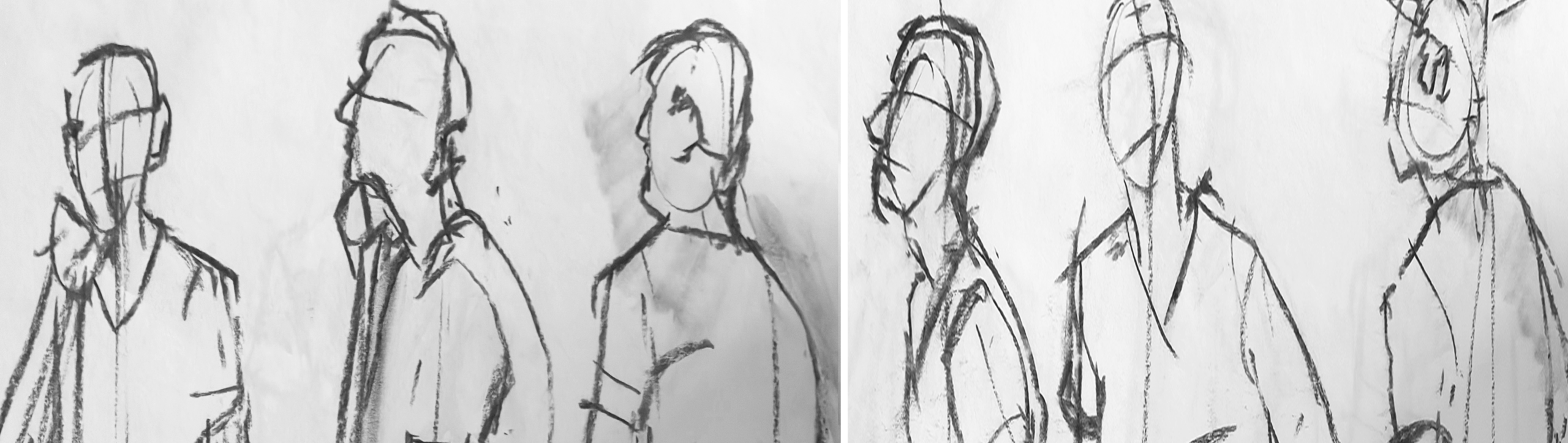
Why Figure Drawing Helps My Abstract Paintings
Because even abstract work needs structure
It doesn’t seem like an obvious connection. I make abstract paintings—no figures, no representation, nothing meant to resemble the body in any direct way. And yet, I keep going back to figure drawing. Not occasionally. Regularly. Because it sharpens something I don’t want to lose.
Looking Is Different From Knowing
Figure drawing forces a kind of attention that’s hard to fake. You can’t rely on what you think a body looks like—the moment you do, the drawing falls apart. Proportions drift, weight disappears, and the whole thing becomes generic. You have to actually look: at angles, at relationships, at how one part shifts because another part moved slightly. That kind of observation carries over directly into my paintings. Even when nothing is representational, the work still depends on relationships—between shapes, between colors, between areas of tension and release. If I stop looking carefully, the paintings flatten out and become predictable.
Structure Matters, Even When It Isn’t Visible
A figure drawing either holds together or it doesn’t. There’s a structure underneath—weight, balance, proportion. You might not be thinking about it consciously, but it’s always there, and when it’s off, you feel it immediately. Abstract painting isn’t any different. There’s no figure to guide the eye, but there is still structure. Something has to hold the painting together and keep it from drifting into decoration. Figure drawing reinforces that sense of underlying order. It reminds me that even the most open, intuitive work needs a backbone—something I think about often in Why I Work in Layers: Building History Into Abstract Painting.
It Slows Me Down
In the studio, I move quickly sometimes. Layers go down, get scraped back, reworked, and decisions build on top of each other. Figure drawing interrupts that rhythm. You’re working within a limited time, responding to something in front of you that doesn’t adjust itself to your preferences. There’s no control in the usual sense—just response. That constraint is useful. It pulls me back into paying attention instead of pushing forward out of habit. That same shift—from controlling to responding—is something that shows up in my painting process, especially when the work starts to push back, something I explore further in When an Abstract Painting Starts Talking Back.
It Keeps Me Honest
In abstraction, it’s possible to get away with things. A mark can feel convincing even if it isn’t doing much, and a composition can look resolved simply because it’s balanced in a familiar way. Figure drawing doesn’t allow that. If something is off, it’s obvious—not conceptually, but visually, immediately. That kind of clarity is uncomfortable, but it’s useful. It recalibrates what I consider “working” and makes it harder to settle too quickly in the studio.
The Body Is Still There
Even though I’m not painting figures, the body doesn’t disappear from the work. It shows up in gesture, in rhythm, in the way a line carries weight or direction, and in how space opens or compresses. Those qualities come from somewhere. Spending time drawing from observation keeps that sense of physicality active. It connects to a long tradition of figure drawing as a way of understanding structure, movement, and proportion.
It’s Not About Switching Directions
Taking figure drawing classes hasn’t changed what I make. It hasn’t made the work more representational or shifted it toward something recognizable. What it has done is deepen the way I see—and that changes everything. The paintings still build in layers and evolve through adjustment and response, but the decisions feel more grounded, even when the result looks completely open. That sense of grounded openness is closely tied to how I think about meaning and connection in The Value of Her Work.
In the end, it comes back to attention—the same reason I work abstractly in the first place. Figure drawing just gives me another way to practice it.