What Is Shown, What Is Felt, and What Never Makes It to the Screen
Lately, she’s been sharing more of her process online—short videos, fragments of movement, moments where a painting is still becoming. On the surface, it seems simple, a way to show how the work unfolds. But something changes when the process is placed inside a feed. The painting becomes visible in a new way—and at the same time, something about it disappears.
A Painting Called “Pretty Storm”
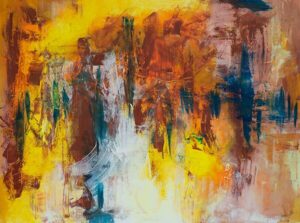
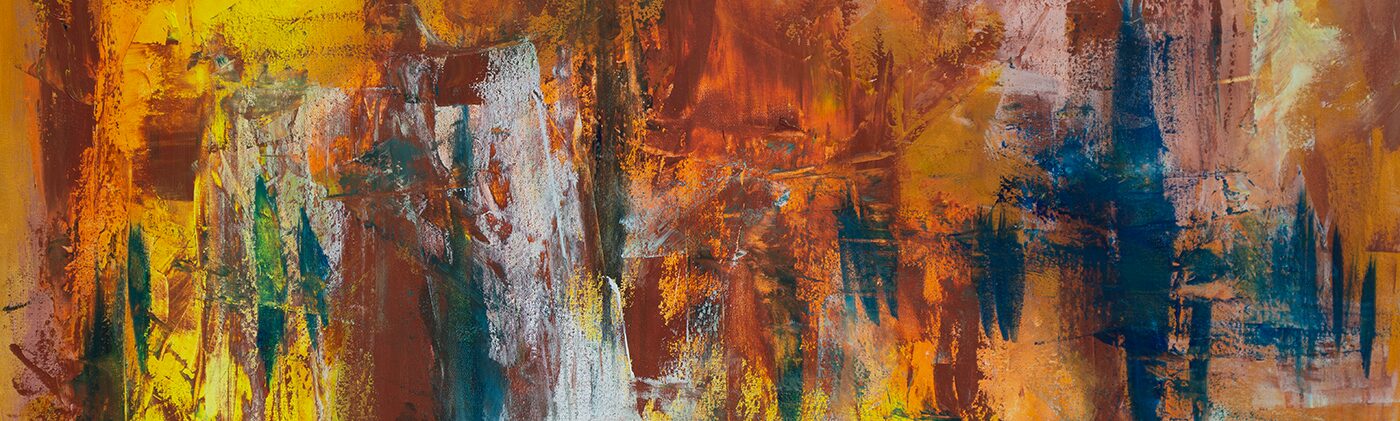
Her most recent work, Pretty Storm, didn’t begin with a fixed idea. It began the way most of her paintings do—with a mark, a reaction, and a willingness to stay with what was uncertain. Color arrived quickly. Heat built across the surface. Areas were pushed, interrupted, partially erased. What looks immediate now was anything but.
That layered development—where the painting evolves through response rather than execution—is something she explores more fully in Why I Work in Layers: Building History Into Abstract Painting.
What the Videos Show
Short-form video captures movement well. A brush dragging across the surface, paint being scraped back, a sudden shift in color—these moments translate easily into something watchable. Platforms built around short-form video reward that kind of clarity. They favor what is immediate, what resolves quickly, what can be understood in seconds.
And in that sense, the videos are useful. They show that the work is physical, that it changes, that it isn’t static. They give viewers a point of entry.
What the Videos Leave Out
But the painting doesn’t happen in those moments alone. What isn’t visible is the pause, the stepping back, the time between decisions, the hesitation before something is changed or left alone. Those parts don’t translate easily into a feed shaped by algorithms that prioritize speed and engagement.
And yet, those quieter stretches are where much of the work actually happens. This tension—between attention and interruption—is something she has been thinking about more broadly in The Internet Is Loud (and It Has No Plans to Lower the Volume).
Pretty Storm Exists in Both Spaces
The painting lives in two versions now. One exists in fragments—clips, gestures, moments of action. The other exists as a whole surface, carrying everything that cannot be reduced to a few seconds of movement. Neither version is wrong, but they are not the same.
The finished work holds history—layers, revisions, decisions that were made slowly or changed entirely. What looks spontaneous is often the result of sustained attention. That relationship between what is seen and what is felt is central to how her work is experienced, something explored in When an Abstract Painting Starts Talking Back.
Why Share It At All?
If video simplifies the process, why show it? Because it also opens something. It allows people to witness that the painting is not a fixed object, but something that evolves. It invites curiosity and makes the work feel accessible without explaining it away.
For some viewers, that is enough to create a connection. And connection—more than explanation—is where the value of the work lives, as considered in The Value of Her Work.
A Balance Between Showing and Holding Back
She doesn’t try to show everything. Some parts of the process remain where they belong—in the studio, in the time that doesn’t translate, in the space where the painting is still deciding what it is. The videos offer an opening, not a complete account. They show enough to invite attention, but not so much that the work loses its depth.
Because in the end, the painting isn’t the clip. It isn’t the moment of action. It’s the accumulation of all of it—including what no one ever sees.
And that is where Pretty Storm holds its weight.
Available Work: