
The Value of Her Work
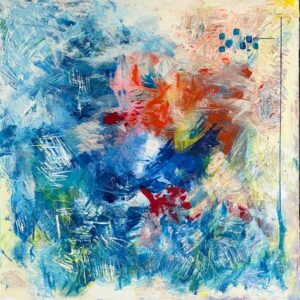
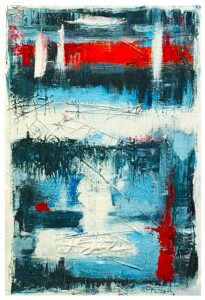
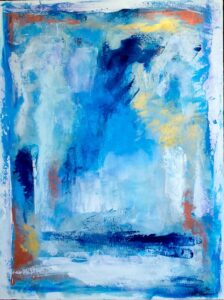
What gives work value? For her, it has never been only about what is produced. It is about what is revealed, what is felt, and what is transformed in the process. The value of her work lives not only in the finished painting, but in the experience it creates—both for herself and for those who encounter it.
As an abstract artist, she does not begin with a fixed answer. She begins with attention—with curiosity and a willingness to listen to what wants to emerge. Her process is layered, intuitive, and honest. It asks for trust and presence, and it asks her to stay open long enough for something real to take shape. That process of listening and responding is explored more deeply in When an Abstract Painting Starts Talking Back.
Her work is not about decoration. It is about connection—creating something that invites reflection, emotion, memory, and meaning. Abstract art has a way of speaking where words fall short. It reaches people differently, leaving room for interpretation, resonance, and personal truth. She values that openness because it honors the viewer’s own inner life.
Each painting becomes a conversation. Not a loud one, not a prescriptive one, but a real one. There is value in work that slows people down, that asks them to feel, to notice, to wonder. In a world that pushes for speed and certainty, her paintings offer something else: space to pause, space to see differently, and space to experience something that cannot be reduced to a simple explanation.
That attention to perception and experience is also shaped by how the work is presented—something considered in Why I Choose Matte Varnish (and Sleep Just Fine Because of It). Even the surface plays a role in how meaning is received.
The value of her work also comes from the life experience behind it. She brings more than technique to the canvas. She brings observation, resilience, instinct, and depth—a way of seeing that has been shaped over time, not just as an artist, but as a person who understands process, change, and the strength it takes to keep showing up authentically.
That is why her work carries energy. It is not rushed or manufactured to fit expectations. It is made through exploration and trust, through a dialogue between intuition and discipline, through knowing when to push, when to pause, and when to let the painting speak for itself. That layered evolution of decision-making is something she develops further in Why I Work in Layers: Building History Into Abstract Painting.
Her work holds tension and movement, softness and structure, freedom and intention. That balance is important to her. It reflects the way she sees life itself—not as something to control completely, but as something to engage with fully.
In the end, the value of her work is not only visual. It is emotional, human, and experiential. It lives in the moment someone stands before a painting and feels something shift—in the quiet recognition of color, texture, motion, or mood, and in the personal meaning each viewer brings. It reflects a deeper truth often associated with aesthetics: that art can communicate in ways language cannot fully contain.
That is the value of her work. She creates not just to make something beautiful, but to make something alive with presence, feeling, and possibility.
Available Work: