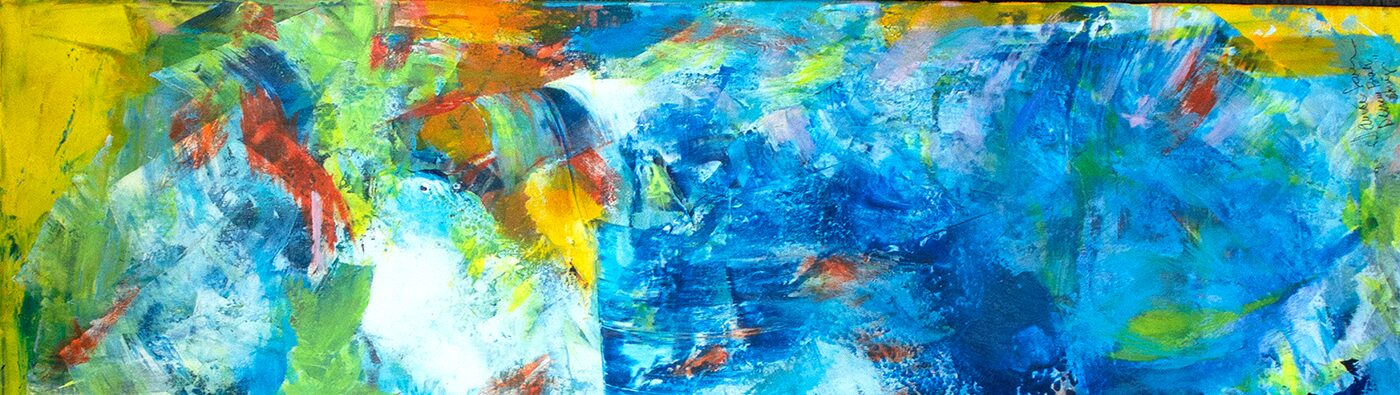
Why I Don’t Start With a Plan
People often assume a painting begins with an idea—a concept, a vision, or a clear destination. That approach certainly has its place. However, it isn’t how I work.I don’t begin with a plan because a plan answers questions too early. In my studio, the questions are often far more valuable than the answers.
A Plan Can Close Things Down
A fixed starting point creates a fixed destination. Once that direction is established, every decision begins serving it. Adjustments become corrections, and the painting moves toward something already known.Abstract painting depends on what isn’t known yet. Instead of illustrating an idea, I allow one to emerge through the process. The The Art Story offers an excellent overview of how abstraction shifted the focus from representation to expression and process.
Starting without a plan leaves room for discovery.
The First Mark Isn’t a Statement
The first mark isn’t a declaration. It’s simply a beginning.It creates movement without defining where that movement will end. What matters isn’t the mark itself, but what it makes possible. As the painting develops, relationships appear, tension builds, and the surface begins suggesting its own direction.
That conversation between artist and painting continues in When an Abstract Painting Starts Talking Back.
Working Without a Plan Is Still Structured
Painting without a plan isn’t random. Instead, it’s responsive.Each decision grows from what already exists. Every layer influences the next, creating structure through observation rather than predetermined design. This process of building, removing, and rebuilding is central to my work and is explored further in Building History Through Layers in Abstract Painting.
The painting doesn’t follow instructions—it develops its own logic.
Discovery Requires Uncertainty
A plan removes uncertainty. Yet uncertainty is often where discovery begins.Without it, there’s little left to respond to—only something to execute. Creativity depends on remaining open long enough for unexpected solutions to appear. Research from the Tate also explores how abstract artists use experimentation and intuition to create meaning beyond recognizable subjects.
Working without a plan preserves that possibility.
Control Happens Later
Not starting with a plan doesn’t mean abandoning control. It simply means delaying it.Eventually the painting begins to settle. Relationships become clearer. Decisions require precision instead of exploration. That’s when editing, refinement, and restraint become just as important as experimentation.
This balance between freedom and intention is closely connected to The Value of My Work as an Abstract Painter.
The Painting Knows Before You Do
Some of the strongest moments in a painting arrive unexpectedly. They weren’t planned, yet once they appear they feel inevitable.Those discoveries don’t come from forcing a direction. They come from allowing one to develop. That’s why I trust the process more than the plan.
In the End, It’s About Staying Available
A plan can make painting more efficient, but efficiency has never been my goal.Attention is.
Remaining open long enough for something genuine to emerge. Allowing the work to evolve before deciding what it should become.
That’s where every painting begins—not with certainty, but with possibility.
If you’d like to see where this process leads, I invite you to explore my gallery of original abstract paintings, browse available artwork, or learn more about my artistic journey.
Available Work: