
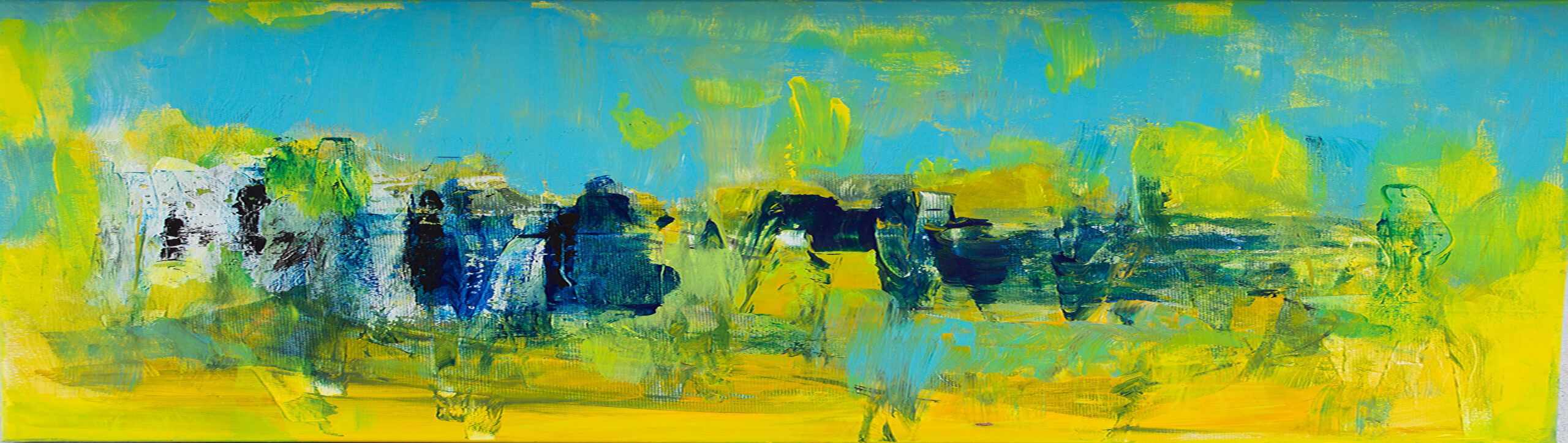
How Abstract Art Transforms a Room (Beyond Decoration)
People often think of art as the final step. Something added once everything else is in place—furniture arranged, colors chosen, lighting set. A finishing touch.
But the right painting doesn’t behave that way. It doesn’t just sit on the wall. It changes how the room feels.
One of the most common questions is whether a painting should match the space. Match the sofa, the palette, the tone. That approach makes sense on the surface, but it usually leads to work that disappears into the room instead of contributing to it. Abstract art works differently. It introduces contrast, movement, and something that wasn’t already there. That shift is what completes the space—not because everything aligns, but because something changes.
Every room has a kind of visual rhythm. Lines, shapes, materials, and light all move the eye in different ways. Without something to anchor that movement, a space can feel scattered. A strong painting organizes that. Not by controlling the room, but by holding it together. That sense of structure—without rigidity—is something I explore more in Why I Work in Layers: Building History Into Abstract Painting.
Scale plays a bigger role than most people expect. Artwork is often chosen too small, placed too cautiously, or treated as secondary. The result is a room that feels incomplete. Larger work changes that immediately. It creates presence and allows everything else to settle around it. The painting doesn’t need to dominate—but it does need to hold its own.
In light-filled spaces, especially in Florida homes, a painting is never static. It shifts throughout the day. Color deepens, softens, and changes depending on the light. Texture appears and recedes. That movement is part of the experience, and it’s one reason abstract work functions so well in these environments. The relationship between perception and the work itself is something I explore further in When an Abstract Painting Starts Talking Back.
Surface also matters more than people realize. In bright interiors, highly reflective finishes can compete with the painting itself. Instead of seeing the work, you see glare. That’s why I tend to work with matte finishes, allowing the surface to remain consistent regardless of lighting conditions. I talk more about that decision in Why I Choose Matte Varnish (and Sleep Just Fine Because of It).
Decoration is immediate. You see it, understand it, and move on. Art works more slowly. A painting that holds a room doesn’t reveal everything at once. It shifts depending on where you stand, how long you look, and what you bring to it. That ongoing interaction is what keeps a space from feeling finished too quickly.
For interior designers, this is where artwork moves from accessory to foundation. It’s not about filling a wall—it’s about shaping how the room is experienced. That perspective is reflected across contemporary design conversations and can be seen in spaces that prioritize light, openness, and intentional placement, such as those explored by ArtConnect Palm Beach, Arts Warehouse, and the Boca Raton Museum Art School.
The difference between decoration and transformation is subtle, but important. Decoration completes a space. Art defines it. When a painting truly works, it doesn’t feel like an addition. It feels like something the room was waiting for.
That idea—what gives a painting lasting presence rather than temporary appeal—is something I explore more in The Value of Her Work.
Because the best artwork doesn’t just sit in a room.
It changes how the room is experienced.