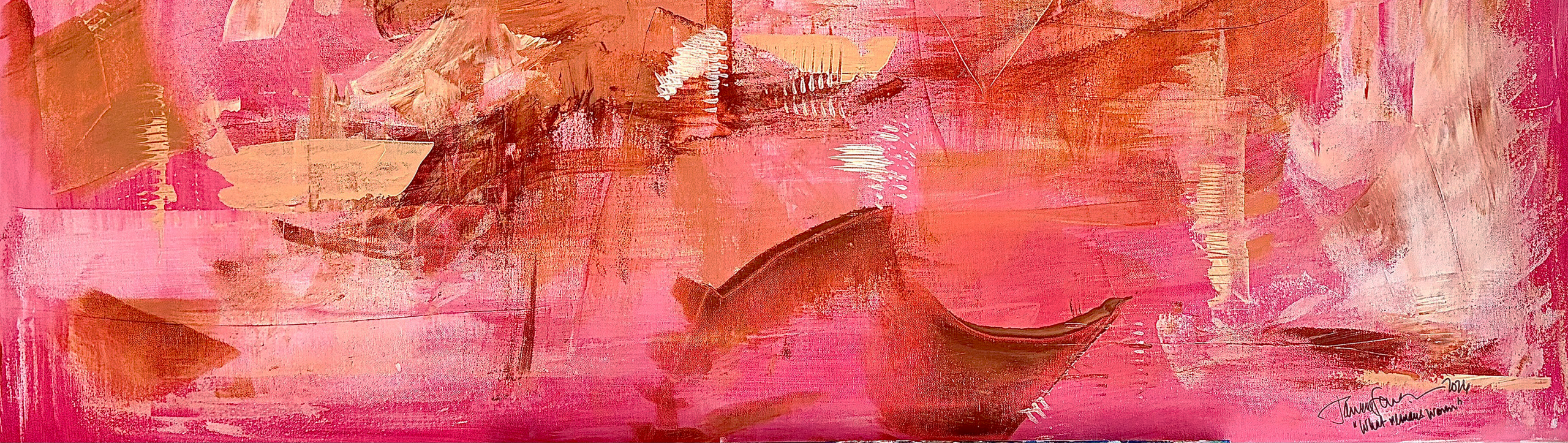
Are Original Abstract Paintings a Good Investment?
People ask this question all the time, usually with a very specific meaning behind it. They’re not really asking about the painting. They’re asking if it will go up in value.
That’s where things get a little off track. Because if you’re only looking at abstract paintings as a financial investment, you’re treating them like stocks—and they don’t behave that way.
I’ve been on both sides of this now: making the work, showing it, selling it, and watching where it goes. I can tell you this—the value of a painting doesn’t move in a straight line, and it definitely doesn’t follow a predictable formula.
There is an art market. Some artwork does increase in value over time. But that usually comes from a combination of factors: consistency of the artist’s practice, visibility, exhibitions, collector interest, and sometimes simple timing. There is no shortcut to that process. Organizations like ArtConnect Palm Beach, exhibition spaces such as Arts Warehouse, and educational programs like the Boca Raton Museum Art School all contribute to helping artists build visibility and develop their work over time.
What I’ve learned is that the more interesting question is not, “Will this painting increase in value?” but rather, “What kind of value does this painting hold?” Because original artwork offers something that reproductions cannot. It carries its history. Every layer, every adjustment, every decision remains embedded in the surface. Even when those layers are hidden, they continue influencing what is visible.
That idea is something I discuss more fully in Why I Work in Layers: Building History Into Abstract Painting. A painting is not simply an image. It is a record of attention, decisions, revisions, and time.
From a collector’s perspective, one of the greatest returns is not financial at all. It is the experience of living with the work. An original painting changes over time—not physically, but through your relationship with it. Different light reveals different qualities. Different seasons bring different responses. Paintings continue unfolding long after they leave the studio.
I’ve had collectors tell me months later that they noticed something entirely new in a piece they see every day. That ongoing conversation between viewer and artwork is part of what makes original art unique. It’s also why I believe meaning matters more than immediate understanding, a theme I explore in When an Abstract Painting Starts Talking Back.
If you are thinking about art strictly as a financial investment, there are practical things to consider. Look for artists who are actively producing work, showing consistently, developing a recognizable voice, and continuing to grow rather than repeating themselves. The broader art market often values sustained practice and artistic development over short-term popularity. Resources such as the art market and art collecting provide useful background on how artwork gains recognition and value over time.
But my advice is always the same: buy artwork you would be happy living with even if it never increased in price.
Abstract painting requires a different kind of trust. There is no obvious subject to validate the purchase. No clear story to explain exactly what you are seeing. Instead, people respond to movement, color, tension, rhythm, and feeling. The connection often happens before the understanding does.
That is why I believe the strongest investment is not financial. It is emotional. It is personal. It is the experience of bringing something into your space that continues to hold your attention year after year.
The question of value—what actually makes artwork meaningful—is something I explore more deeply in The Value of Her Work.
So, are original abstract paintings a good investment?
They can be. But not in the way most people expect.
The best investments are the ones you would choose even if nobody could predict the future. The paintings you keep looking at. The ones that continue revealing themselves over time. The ones that become part of your life.
Everything else—the market, the pricing, the recognition—grows around that.
You can view available work here:
Saatchi Art.